Examples
Note: This page is a work in progress!
[2]:
%matplotlib inline
import numpy as np
import msynchro
import matplotlib.pyplot as plt
from msynchro.units import unit
import test
test.set_mpl_defaults()
Example Synchrotron Calculations
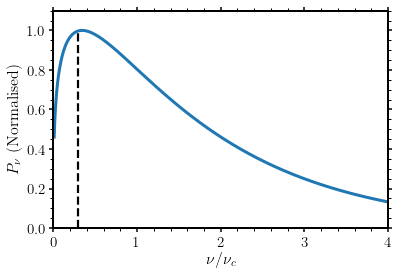
A synchrotron calculation can be carried out using a few simple commands. First, we can plot the spectrum emitted by a single synchrotron electron.
[3]:
# specify a Lorentz factor and a reasonable range of frequencies
gamma = 1000.0
B = 1e-6
nu_c = msynchro.nu_crit(gamma, B)
nu = np.linspace(0.01 * nu_c, nu_c * 4.0, 1000)
Pnu = msynchro.psynch(gamma, nu, B)

# plot result
plt.plot(nu/nu_c, Pnu / np.max(Pnu), lw=3)

# plot limits
plt.ylim(0,1.1)
plt.xlim(0,4)
plt.vlines([0.29], 0, 1, ls="--")
plt.xlabel(r"$\nu/\nu_c$", fontsize=16)
plt.ylabel(r"$P_\nu$ (Normalised)", fontsize=16)
[3]:
Text(0, 0.5, '$P_\\nu$ (Normalised)')
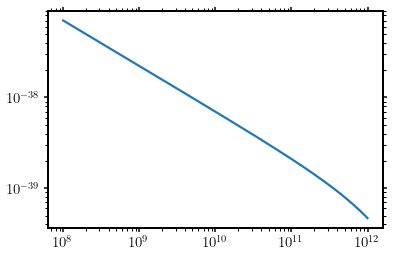
Now we can plot the spectrum from a distribution of electrons.
[6]:
nu = np.logspace(8,12,1000)
energies = np.logspace(8,12,1000)
ne = energies ** -2.0
B = 1e-6
spec = msynchro.Ptot(nu, energies, ne, B)
plt.loglog(nu, spec)
[6]:
[<matplotlib.lines.Line2D at 0x11fea4fd0>]
Example Particle Evolution Calculations
A population of particles can be evolved using the tridiagonal matrix algorithm by specifying arrays holding the initial particle states, and the cooling rates.
[ ]: